About Rigid Coupling
Rigid Coupling
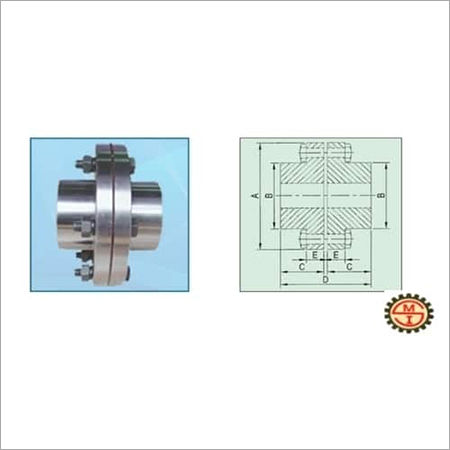
Specifications :
| Coupling Size | Finish Bore | Ø A | Ø B | C | Ø D | E | Weight kg. | Max. RPM |
| Min. | Max. |
| DRC 100 | 10 | 50 | 120 | 70 | 46.5 | 93 | 15 | 7 | 8000 |
| DRC 101 | 20 | 60 | 170 | 85 | 57.5 | 115 | 17 | 14 | 6300 |
| DRC 102 | 30 | 75 | 185 | 110 | 72.5 | 145 | 17 | 21 | 5000 |
| DRC 103 | 40 | 90 | 220 | 130 | 87.5 | 175 | 20 | 35 | 4000 |
| DRC 104 | 50 | 110 | 250 | 160 | 107.5 | 215 | 20 | 52 | 3350 |
| DRC 105 | 60 | 130 | 200 | 185 | 115 | 230 | 25 | 75 | 2800 |
| DRC 106 | 75 | 150 | 320 | 215 | 130 | 260 | 28 | 108 | 2800 |
| DRC 107 | 90 | 170 | 350 | 240 | 145 | 290 | 28 | 145 | 2100 |
| DRC 108 | 105 | 200 | 380 | 285 | 160 | 320 | 25 | 175 | 1900 |
| DRC 109 | 125 | 220 | 430 | 315 | 170 | 340 | 25 | 268 | 1700 |
| DRC 110 | 140 | 260 | 490 | 370 | 185 | 370 | 25 | 388 | 1400 |
Engineered for Precision and VersatilityRigid couplings are manufactured for high-precision alignment with less than 0.05 mm TIR, ensuring efficient power transmission and minimizing vibration. Their versatile design accommodates both keyed and plain bores, with customizations available upon request, making them suitable for a broad array of shaft and pipe connection needs across industries.
Robust Construction for Demanding EnvironmentsConstructed from mild steel or stainless steel, these couplings are treated with surface finishes like black oxide or phosphating to enhance durability and corrosion resistance. Designed to perform reliably in temperatures from -40C to 200C, they withstand harsh industrial environments while maintaining consistent performance and minimal wear.
Flexible Mounting Options and International StandardsOptions for axial and radial set screws, bolts, clamp/split connections, and both one-piece and two-piece structures allow for secure and adaptable mounting. Our rigid couplings are manufactured in compliance with DIN, ISO, and ANSI standards, making them compatible with broad industrial machinery specifications.
FAQs of Rigid Coupling:
Q: How are rigid couplings installed on shafts or pipes?
A: Rigid couplings are typically installed using axial and radial set screws or bolts, depending on the specific design. The clamp or split connection ensures a secure fit, and installation can be performed with standard tools. Detailed instructions and custom options are available to suit various requirements.
Q: What is the main benefit of using a high-precision rigid coupling?
A: A high-precision rigid coupling ensures exceptional shaft alignment with less than 0.05 mm Total Indicator Reading (TIR). This reduces vibration and wear, leading to smoother operation and extended machinery lifespanespecially vital in power transmission and industrial applications.
Q: Where are these rigid couplings commonly used?
A: These couplings are ideal for connecting pipes and shafts in industrial machinery, power transmission systems, and equipment requiring rigid, backlash-free connections. They are widely used across manufacturing, automation, and heavy-duty mechanical systems.
Q: What customization options are available for these couplings?
A: Bore sizes, lengths, diameters, and surface finishes can be customized to meet specific application needs. Both keyed and plain bores are offered, and customers can request special dimensions, materials, or designs to ensure compatibility with their equipment.
Q: Which processes are used in the manufacturing of these rigid couplings?
A: Precision machining techniques are applied to produce couplings with high accuracy and surface finish. Surface treatments such as black oxide and phosphating are used to enhance corrosion resistance, and thorough quality checks ensure conformity with DIN, ISO, or ANSI standards.
Q: What materials are available, and how do they affect corrosion resistance?
A: Rigid couplings are mainly offered in mild steel or stainless steel. Stainless steel variants provide superior corrosion resistance, while specific surface treatments like phosphating or black oxide further improve durability, especially in harsh or outdoor environments.
Q: When should a rigid coupling be chosen over a flexible coupling?
A: Choose a rigid coupling when absolute shaft alignment is required and there is minimal shaft misalignment, as they do not accommodate angular, parallel, or axial displacement. Theyre ideal for precise, backlash-free connections where rigidity and exact alignment are critical.





 Send Inquiry


 Send Inquiry